
Learn Wedges
What is a wedge?
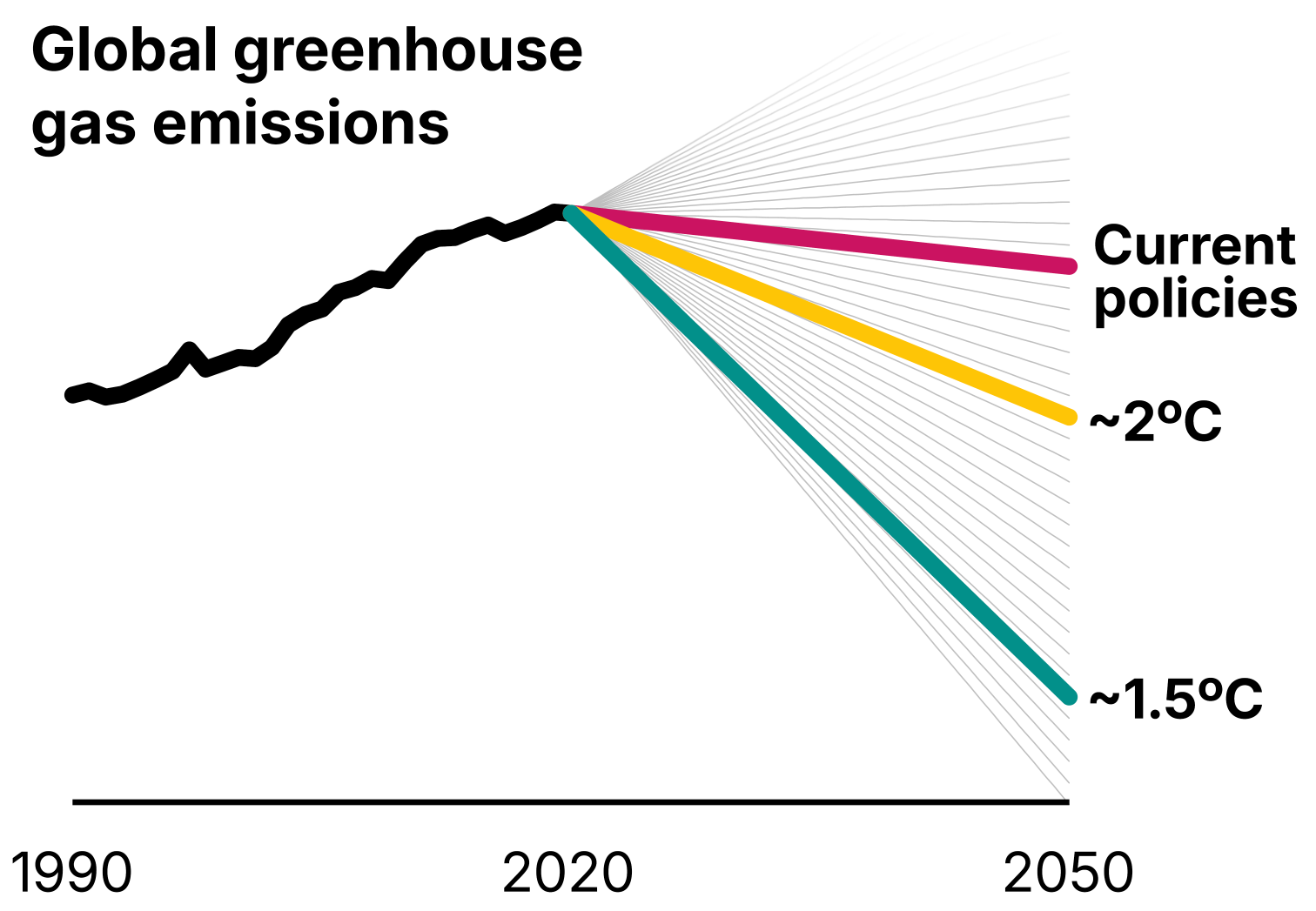
Climate wedges turn the huge problem of global decarbonisation into smaller building blocks you can play with. Each wedge is the same sized chunk of emissions reduction.
You choose which actions deliver your wedges, stack them up, and see what kind of decarbonisation pathway your choices create.
What a wedge means
A wedge is a building block of climate change mitigation. A wedge from any strategy has the same scale, whether it comes from building nuclear reactors or eating less meat. Each wedge ramps up linearly from nothing in 2020 to saving 2 billion tonnes of CO₂-equivalent in 2050. In total, each wedge amounts to 30 billion tonnes avoided over those 30 years.
Emissions savings are counted in CO₂ equivalent, covering all greenhouse gases. This includes emissions that occur upstream from fuel production, and from the electricity needed to power strategies (like electric vehicles or heat pumps). It excludes embodied emissions in new capital and infrastructure.
Baselines and additionality
To bend the emissions curve down, you must start with a baseline pathway: what will happen if we don't act.
By default this is the 'Current Policies' scenario that reflects the actions that governments around the world have committed to. Countries might back-track on their pledges, or progress on some solutions may stall - so you might want to explore what is needed relative to a 'No Policy' counterfactual, or anywhere in between.
For any wedge, deployment must be additional to that which occurs in your chosen baseline scenario. Solar power and electric vehicles are being deployed rapidly already, so acheiving a wedge of them means going even further.
Using the wedges
To build a pathway, start by deciding how many wedges you want to achieve relative to your baseline. The number of wedges you choose will determine how far the world will warm in the future: see the next section on relating wedges to warming.
What is a wedge?
Get started with the language of climate wedges, and why they are a useful unit for climate action planning.
Relating wedges to warming
Understand how wedges of emissions reduction will influence global warming. Future temperatures depend on the baseline trajectory and how many wedges bend this downwards.
Strategies that can deliver wedges
Learn about the actions that can deliver climate wedges across sectors: what can have an impact, and how widely it must be deployed.
Trade-offs between strategies
Strategies can reinforce or constrain each other. Read through the interactions, co-benefits, and potential tensions that might influence your pathways.