
Learn Warming
Relating wedges to warming
Stack up wedges and watch global temperatures respond. Each wedge is a standard slice of mitigation that cuts future emissions. But temperature responses are complex, changing over time, and with how many wedges are deployed.
Warming follows total emissions
The key idea is simple: lower emissions in the future means less warming. Global temperature responds to the total amount of heat-trapping gases we put in the air, accumulating year after year.
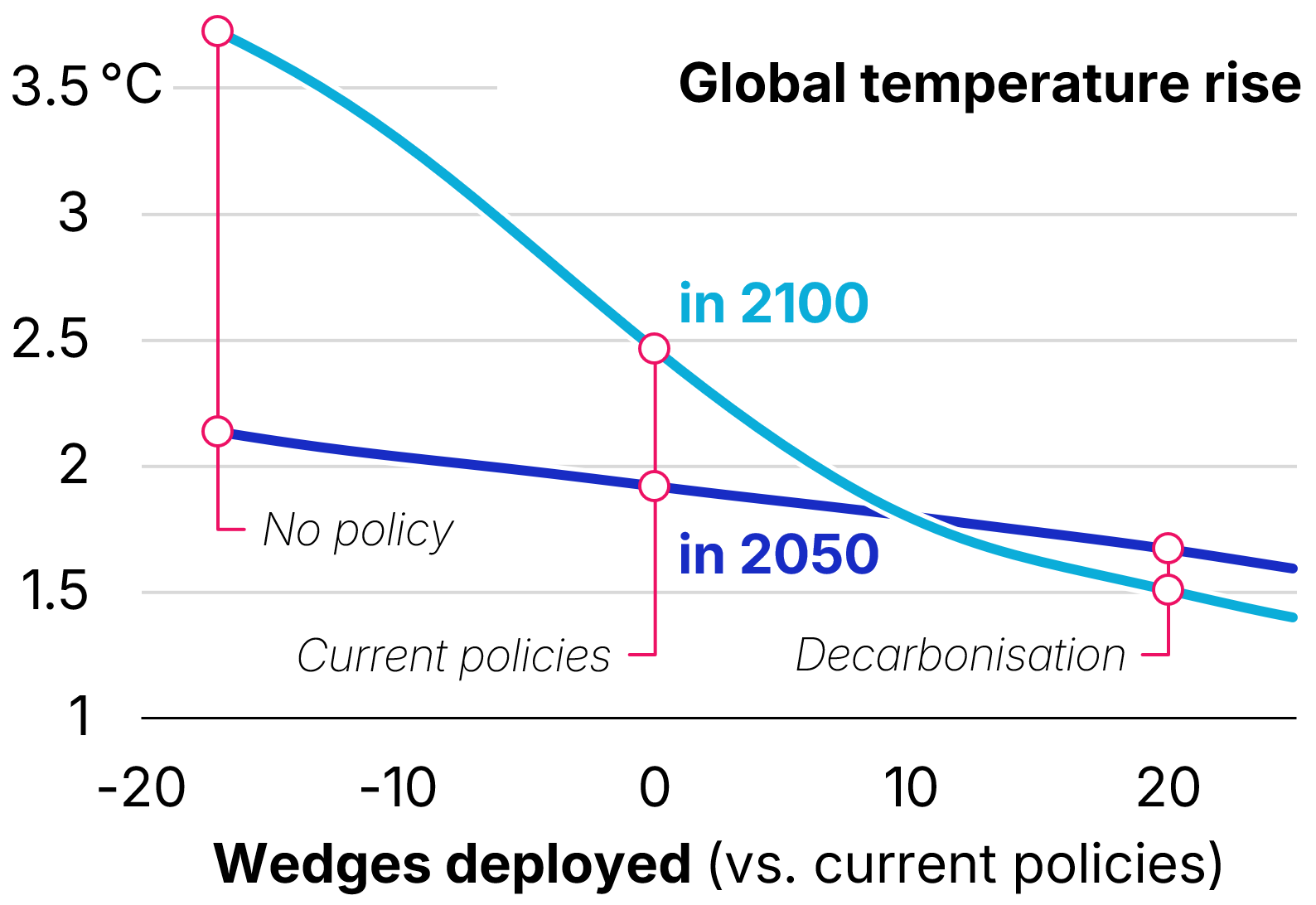
If governments continue with their current policies, the world is on course to be 1.9°C degrees warmer than pre-industrial times in 2050. By 2100, this rises further to 2.5°C.
If you deploy 20 wedges beyond this, temperatures in 2050 are only slightly lower, but by 2100 Earth can begin cooling, getting back to 1.5°C.
If we backtrack to a 'no policy' pathway, the world will be more than 2°C warmer by 2050, and temperatures then escalate to 3.7°C by 2100.
Effects compound over time
Each wedge has the same effect on temperatures in 2050: eight wedges cuts temperature by one-tenth of a degree. But they can have a 5x larger impact on temperatures in 2100, because cutting earlier keeps emissions lower for longer, and puts the world on a low-carbon path beyond 2050.
How the app turns wedges into degrees
In the game, you choose a baseline future and then add wedges on top. The temperature readout is calculated from the link between total emissions and warming, calculated from a large set of published climate model scenarios.
What is a wedge?
Get started with the language of climate wedges, and why they are a useful unit for climate action planning.
Relating wedges to warming
Understand how wedges of emissions reduction will influence global warming. Future temperatures depend on the baseline trajectory and how many wedges bend this downwards.
Strategies that can deliver wedges
Learn about the actions that can deliver climate wedges across sectors: what can have an impact, and how widely it must be deployed.
Trade-offs between strategies
Strategies can reinforce or constrain each other. Read through the interactions, co-benefits, and potential tensions that might influence your pathways.